
Once Upon A Burning Mattress


This is perhaps a stretch but I think the Napoleon pastry— known as a mille-feuille in France which means literally “a thousand sheets” —looks like an edible mattress. And let me stretch even further and connect the cartoon above to the subject of this post— sleep.
Ok, the emperor doesn’t look very comfortable on top of a dessert. But here’s another representation of how Napoleon might have caught 40 winks during one of the 60 battles his armies fought.

It has become part of his legend that Napoleon functioned on very little sleep. Historians contend that he only needed four hours a day but an alleged quote of Napoleon’s seems to contradict this. How much sleep did he actually think was necessary?
“Six hours for a man, seven for a woman and eight for a fool.”
Donald Trump, who may think he's Napoleon, claims he only sleeps four hours a night. Of course he could be lying and has somebody else tweeting for him around the clock to make it appear that he's awake when he isn't.
Remember he cheats at golf and anything else he possibly can. However, it wouldn't be surprising that in this instance it isn’t fake snooze and against all odds he may actually be telling the truth. There have been other world leaders who were nearly sleepless in their saddles including Margaret Thatcher and Bill Clinton.
But then there's also Albert Einstein, who slept 10 hours at night and took a nap in the afternoon. So, I guess when one theorizes about equating sleep with energy, there's a certain amount of relativity involved.
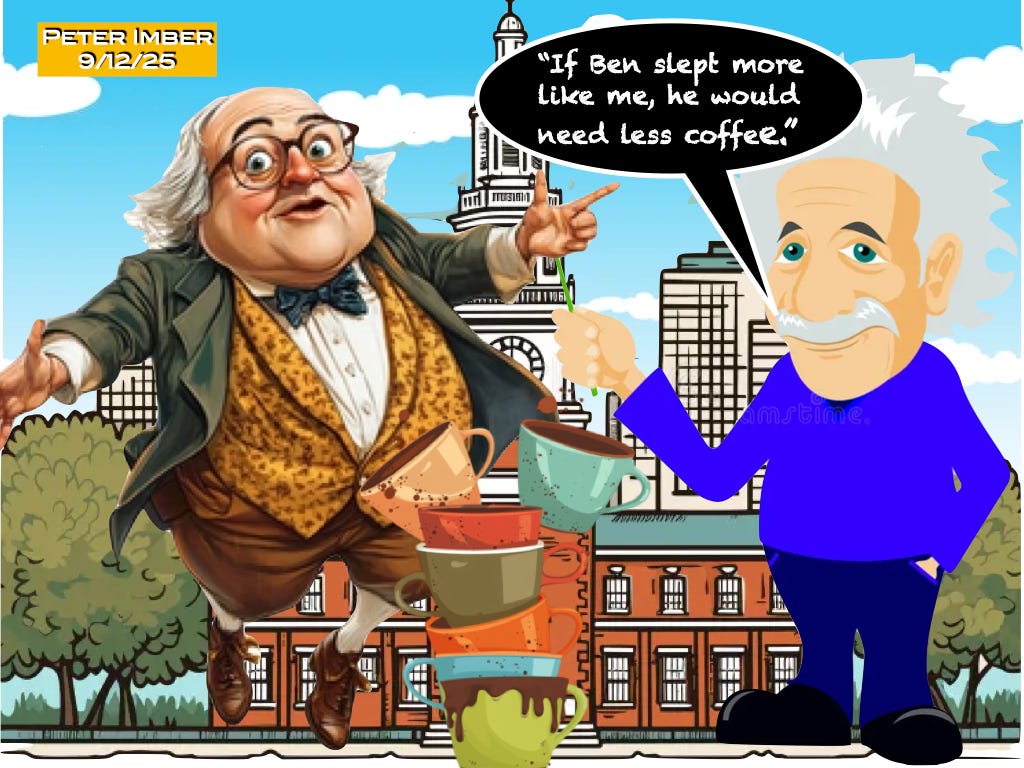
Take Benjamin Franklin. He was the human version of the Swiss Army Knife before there was a Swiss Army Knife. Franklin, who we have been led to believe packed it in early and rose with the sun retired nightly at 10 p.m.— which isn’t all that early to bed —but he did get up 7 hours later at 5 a.m. and in Pennsylvania that’s before sunrise on every day of the year.
Ben followed two other bits of his famous advice and fulfilled the healthy and wealthy parts. Franklin lived to be 84 and in 18th century dollars died a multimillionaire. But there was perhaps another explanation for his tireless vigor.
He, as well as Thomas Jefferson, was a big coffee drinker. How big? Franklin spent almost three decades of his life in England and France and while there he had his personal mail delivered to coffee houses.
And there is another claim that I’ve checked out and discovered is true. Most of us do spend a third of our existence in bed. The time we spend working in our careers pales in comparison.
During my various jobs from age 22 to 63, I put in a lot of overtime hours. Even with them and after subtracting days off, vacation and commuting to and from work, the figure I came up with is about 14 years of actual time that I worked— almost a third of the total hours I lived during that span of 42 years.
Add an equal third that was me not working and the other third of me asleep and we’ve pretty much accounted for how I spent all my summers, falls, winters and springs for much of my time on earth before I retired.
Sleeping for a third of your life seems like a large number and if I live to be 80, I will likely have spent 33 years in bed— 26 of them actually asleep and perhaps another 7 lying there intending to.
The information I used for my calculations was gathered by a British organization called the Sleep Matters Club. It claimed it used 15 sources to create its data which its researchers accomplished in their waking hours of course.
So, what's the most important thing in my house besides my wife? It's a no brainer. It’s our mattress! We didn't mess around when we bought it. We went to a store with a big selection of those we could try out and we picked a winner.
Last year after more than two decades we bought a new one after again reclining and declining until we found our suitable replacement.
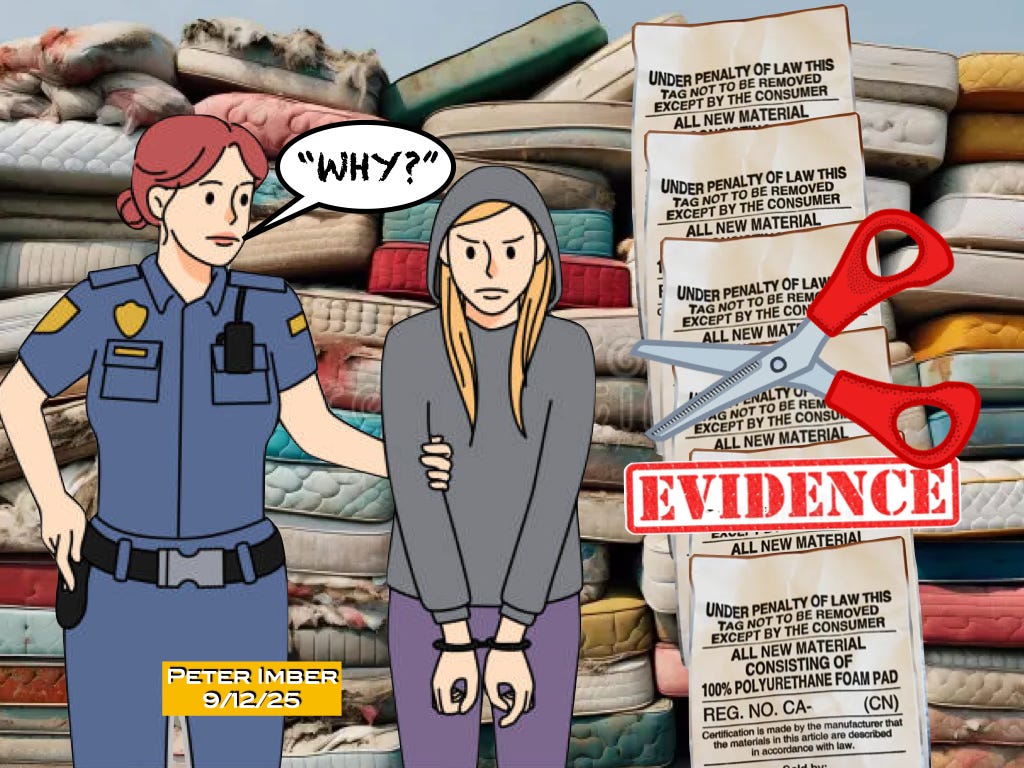
Remember the tag on a mattress that warned that its removal was forbidden and punishable by law? Not taking any chances, many of us wouldn’t touch it and anytime we changed the sheets we were reminded that we hadn’t.
Turns out we could have ripped it off. The warning was for the seller and the protection of the consumer.
Once long ago, I and some friends settled for mattresses that never had tags to begin with. I was living on the Upper West Side of Manhattan. Friends and I had signed on to share an apartment together soon after graduating from college. We each brought our own stuff but two items none of us had were a bed frame and a mattress.
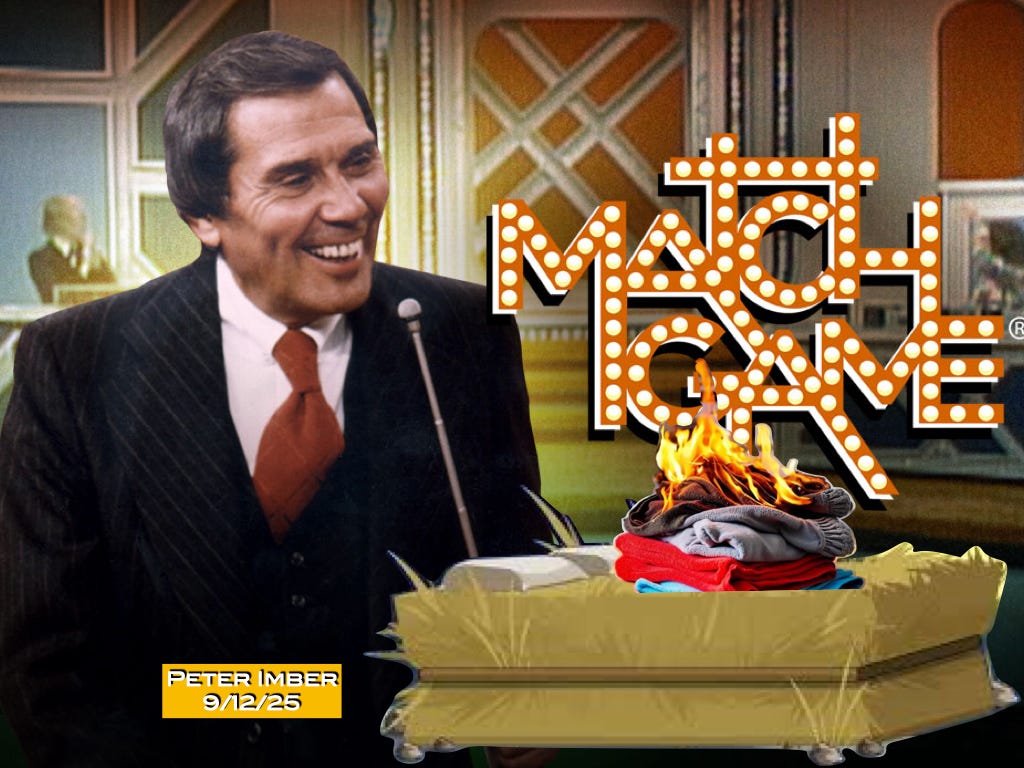
The landlord noticed this and said he had a landlord friend who just so happened to want to dispose of four beds with mattresses. The building was nearby and we found out it was owned by television game show host Gene Rayburn (Remember Match Game?)
One look at what we were being offered and it was apparent why Rayburn wanted to get rid of the mattresses. They were stuffed with straw. I had never seen one before. I had no idea straw mattresses even still existed except possibly in recreations of the bedrooms of colonial homes at a tourist attraction like Old Sturbridge Village.
Hey, we were pretty desperate so we hauled them back to our place and for a few months all was well.
We did our laundry at a laundromat around the corner on Columbus Avenue and a few times I found that my clothes were so hot out of the dryers there I had to juggle them on my way back to our apartment. My roommates were experiencing the same thing.
One night I was returning from playing basketball at a nearby Y and as I rounded the corner from Amsterdam Avenue onto our street, I saw fire trucks in the distance. I started to run when it became clear they were outside our brownstone and arrived just in time to see a couple of firemen dragging a smoking wet mattress out the front door.
It only took another moment to figure out what had happened when another fireman brought out a pile of burnt clothing.
One of us had returned from the laundromat earlier that evening and thrown his hot load of clothes on his bed. He'd gone out right afterward and no incendiary device other than his socks and underwear was needed for his mattress to smolder and eventually ignite.
The smoke damage was extensive. My own clothes went through the dry cleaner’s four times. For years afterward the books and records I had on the shelves smelled like they'd been cured in a smokehouse.
Upon recalling this now, I wonder if Gene Rayburn ever found out that his mattresses could have been the inspiration for a new version of Match Game that didn't require any matches at all.
And Napoleon's mattress? It’s doubtful he ever slept on one stuffed with straw. He was on the march quite a lot and desired the utmost comfort when he took his short breaks from warring for napping. His mattress was likely the most elegant of that time and made of some type of woven fabric.
About the only straw mattress for sale now that I could find is in the picture below. It’s less than two feet long and was made for a Victorian era doll.
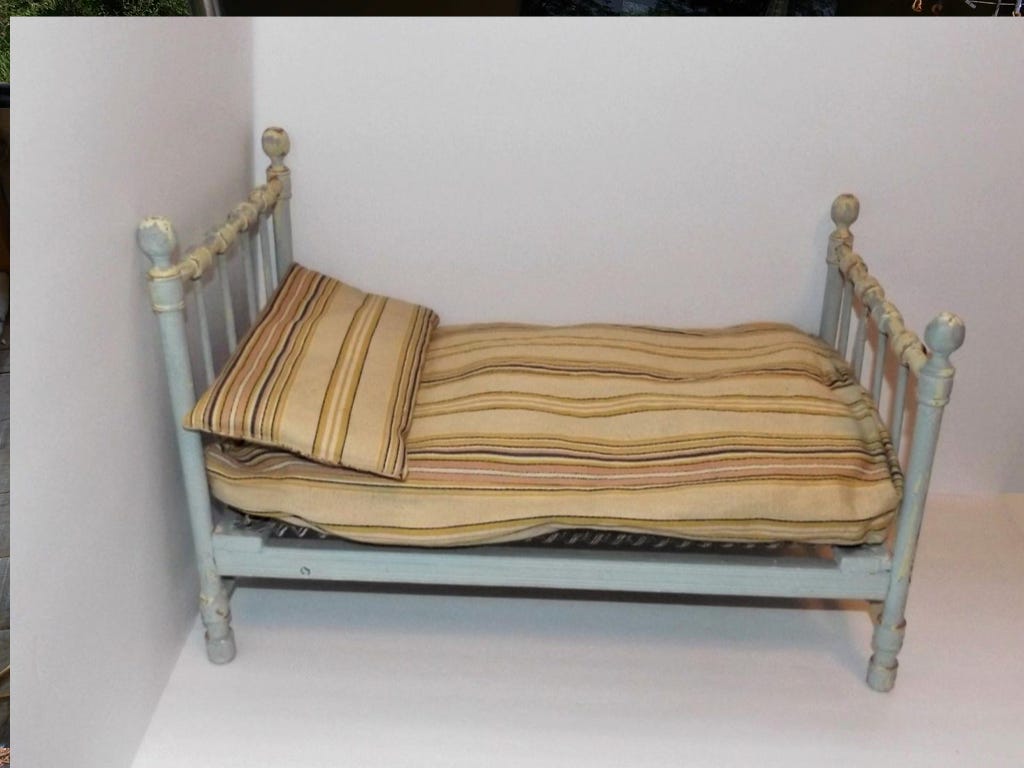
There are YouTube videos if you want to make a regulation straw mattress of your own. Home Depot sells a bale of straw for $34.98 plus shipping. If you want a king— but likely not fit for one —you might need two bales.
And to go with your new/old mattress how about a pillow guaranteed not to be inflammable but also surely to give you a headache. Turns out that the earliest pillows can be traced to about 9,000 years ago in Mesopotamia.
Those pillows apparently served a practical purpose by keeping bugs and vermin out of the mouths, eyes, and noses of the wealthy. In order to be effective at doing that, they weren’t made of straw. They were solid stone… Pleasant dreams!
